
Blog
  1. Home /
  2. Blog

Blog

Important topics you need to know about your heart health and preventive health recommendations.

In the following articles, you can find information about heart diseases, symptoms, treatment methods and preventive measures.

What is Myocarditis? Symptoms, Causes, and Treatment

What is Myocarditis? Symptoms, Causes, and Treatment

This content has been prepared for informational purposes to protect public health, in compliance with the regulations of the Ministry of Health of the Republic of Turkey and medical ethical rules. It does not provide any diagnosis, treatment guarantees, or specific medical advice. Please consult a qualified healthcare provider for the most accurate information. Myocarditis is an inflammation of the heart muscle, most commonly triggered by viral infections. Often cited as a leading cause of “sudden death in young people,” this condition can range from a mild illness with vague symptoms to life-threatening heart failure. In this comprehensive guide, I explain what myocarditis is, its symptoms, causes, and the treatment journey. What is Myocarditis? # Myocarditis is the inflammation of the myocardium, the thick muscular layer of the heart wall. This inflammation can cause heart muscle cells (myocytes) to become damaged or die. Damage to the heart muscle can weaken the heart’s ability to pump blood and disrupt its electrical system, leading to irregular heart rhythms (arrhythmias).
What is Diabetic Foot? Symptoms, Treatment, and Prevention Methods

What is Diabetic Foot? Symptoms, Treatment, and Prevention Methods

··17 mins
This content has been prepared for informational purposes to protect public health, in compliance with the regulations of the Ministry of Health of the Republic of Turkey and medical ethical rules. It does not provide any diagnosis, treatment guarantees, or specific medical advice. Please consult a qualified healthcare provider for the most accurate information. Diabetic foot is a serious complication that develops in diabetic patients and affects the feet. This condition, resulting from the combination of nerve damage (neuropathy) and vascular disease (vasculopathy), significantly increases the risk of wound formation, infection, and amputation. But the good news is that the vast majority of diabetic foot complications are preventable! In this comprehensive guide, I will discuss in detail what diabetic foot is, risk factors, symptoms, treatment methods, and most importantly, how it can be prevented. What is Diabetic Foot? # Diabetic foot describes a series of complications affecting the feet in diabetic patients. Prolonged high blood sugar leads to two main problems in the body:
Tricuspid Valve Disease: Causes, Treatment and Transcatheter Interventions

Tricuspid Valve Disease: Causes, Treatment and Transcatheter Interventions

This content has been prepared for informational purposes to protect public health, in compliance with the regulations of the Ministry of Health of the Republic of Turkey and medical ethical rules. It does not provide any diagnosis, treatment guarantees, or specific medical advice. Please consult a qualified healthcare provider for the most accurate information. Tricuspid valve disease is dysfunction of the valve between the right atrium and right ventricle. Tricuspid regurgitation is most common. Modern transcatheter interventions offer promising treatment options for patients who are high risk for surgery. What is Tricuspid Valve Disease? # The tricuspid valve regulates blood flow from the right atrium to the right ventricle. In valve disease, this function is impaired and creates additional burden on the right heart.
TAVI Treatment: Minimally Invasive Aortic Valve Replacement

TAVI Treatment: Minimally Invasive Aortic Valve Replacement

··14 mins
This content has been prepared for informational purposes to protect public health, in compliance with the regulations of the Ministry of Health of the Republic of Turkey and medical ethical rules. It does not provide any diagnosis, treatment guarantees, or specific medical advice. Please consult a qualified healthcare provider for the most accurate information. Transcatheter Aortic Valve Implantation (TAVI) is a revolutionary treatment developed for patients with severe aortic stenosis. As an alternative to open-heart surgery, this minimally invasive procedure allows patients to recover faster and regain their quality of life. What is Aortic Valve Disease? # The aortic valve is the “door” between the heart’s left ventricle and the aorta, the body’s main artery. It ensures that blood flows in the correct direction as it’s pumped from the heart to the rest of the body. A normal aortic valve consists of three leaflets (tricuspid) that open and close with perfect synchronization with each heartbeat. Over time, however, this valve can deteriorate for various reasons, leading to two main problems:
MitraClip and Tricuspid Valve Interventions - Minimally Invasive Valve Treatment

MitraClip and Tricuspid Valve Interventions - Minimally Invasive Valve Treatment

··11 mins
This content has been prepared for informational purposes to protect public health, in compliance with the regulations of the Ministry of Health of the Republic of Turkey and medical ethical rules. It does not provide any diagnosis, treatment guarantees, or specific medical advice. Please consult a qualified healthcare provider for the most accurate information. Heart valve diseases, especially mitral and tricuspid regurgitation, are conditions that seriously affect quality of life. While traditional open-heart surgery carries high risk for many patients, minimally invasive methods such as MitraClip and tricuspid valve interventions offer promising alternatives. In this comprehensive guide, I will discuss non-surgical valve treatment methods, indications, procedure process, and expected outcomes in detail. What is Heart Valve Regurgitation? # Heart valves are structures that ensure one-way blood flow between heart chambers and between the heart and major vessels. Valve regurgitation means the valve does not close completely, causing blood to leak backward. This creates extra load on the heart and can lead to heart failure over time.
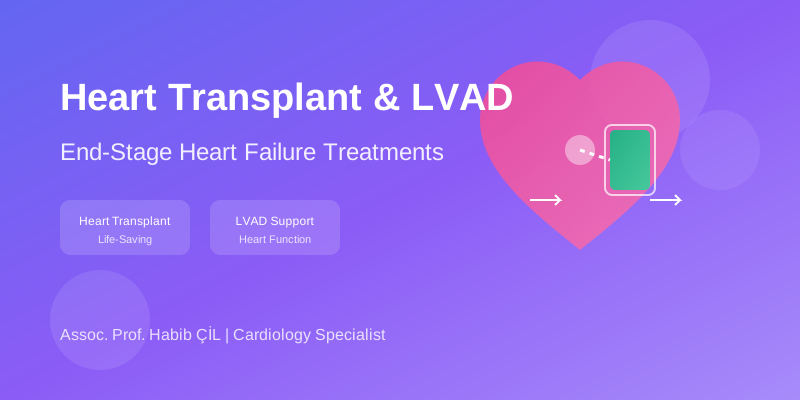
Heart Transplant & LVAD: End-Stage Heart Failure Treatments

Heart Transplant & LVAD: End-Stage Heart Failure Treatments

··17 mins
This content has been prepared for informational purposes to protect public health, in compliance with the regulations of the Ministry of Health of the Republic of Turkey and medical ethical rules. It does not provide any diagnosis, treatment guarantees, or specific medical advice. Please consult a qualified healthcare provider for the most accurate information. End-stage heart failure is an advanced condition where the heart cannot pump enough blood to meet the body’s needs. Modern medicine offers two important weapons against this serious disease: heart transplant and LVAD (left ventricular assist device). This comprehensive guide examines the details of both treatment methods, who they are suitable for, success rates, risks, and their effects on patients’ quality of life. Heart Transplant & LVAD: Hope in End-Stage Heart Failure # End-stage heart failure is a condition where the heart’s pumping function is severely impaired, patients have difficulty performing daily activities, quality of life is significantly reduced, and life expectancy is shortened. Traditional medication therapies and lifestyle changes are insufficient at this stage. Fortunately, heart transplant and mechanical circulatory support devices (especially LVAD) offer life-saving options for these patients.
Cardiac Rehabilitation - Improving Quality of Life After Heart Disease

Cardiac Rehabilitation - Improving Quality of Life After Heart Disease

··12 mins
This content has been prepared for informational purposes to protect public health, in compliance with the regulations of the Ministry of Health of the Republic of Turkey and medical ethical rules. It does not provide any diagnosis, treatment guarantees, or specific medical advice. Please consult a qualified healthcare provider for the most accurate information. The recovery process after a heart attack, angioplasty, bypass surgery, or other cardiac events involves not only physical but also psychological and social dimensions. Cardiac rehabilitation is an evidence-based program that ensures patients recover optimally, improve their quality of life, and prevent future cardiac events. In this comprehensive guide, I will detail what cardiac rehabilitation is, who it is suitable for, how it is implemented, and the benefits it provides. What is Cardiac Rehabilitation? # Cardiac rehabilitation is a medically supervised, comprehensive program that supports the physical, psychological, and social recovery of patients with heart disease or who have experienced a cardiac event. It is recommended at Class I (highest) recommendation level by the World Health Organization (WHO) and the American Heart Association (AHA).
Aortic Aneurysm: Symptoms, Diagnosis and Modern Treatment Methods

Aortic Aneurysm: Symptoms, Diagnosis and Modern Treatment Methods

··10 mins
This content has been prepared for informational purposes to protect public health, in compliance with the regulations of the Ministry of Health of the Republic of Turkey and medical ethical rules. It does not provide any diagnosis, treatment guarantees, or specific medical advice. Please consult a qualified healthcare provider for the most accurate information. An aortic aneurysm is a balloon-like enlargement of the aorta, the body’s main artery, due to weakening of the vessel wall. This serious condition can progress silently and carries rupture risk but can be controlled with early diagnosis and appropriate treatment. This comprehensive guide examines aortic aneurysm types, symptoms, risk factors, diagnostic methods, and current treatment options. What is an Aortic Aneurysm? # The aorta is the main artery that emerges from the heart and distributes oxygenated blood throughout the body. The aortic wall consists of three layers: intima (inner layer), media (middle layer), and adventitia (outer layer). An aortic aneurysm is the enlargement of the aorta by at least 50% of its normal diameter due to weakening of these wall layers.
What is Peripheral Artery Disease? Symptoms, Diagnosis, and Treatment

What is Peripheral Artery Disease? Symptoms, Diagnosis, and Treatment

··9 mins
This content has been prepared for informational purposes to protect public health, in compliance with the regulations of the Ministry of Health of the Republic of Turkey and medical ethical rules. It does not provide any diagnosis, treatment guarantees, or specific medical advice. Please consult a qualified healthcare provider for the most accurate information. Peripheral artery disease (PAD) is a serious circulatory disorder that occurs when arteries in the legs and arms narrow or become blocked. This condition, which usually develops due to atherosclerosis (hardening of the arteries), can prevent serious complications with early diagnosis and appropriate treatment. In this comprehensive guide, I will discuss in detail what peripheral artery disease is, its symptoms, risk factors, diagnostic methods, and treatment options. What is Peripheral Artery Disease? # Peripheral artery disease is a condition where arteries outside the heart and brain narrow or become blocked. It most commonly affects leg arteries but can also affect arteries going to the arms, stomach, kidneys, and other organs. The disease usually develops as a result of atherosclerosis, a process where fatty plaques accumulate on artery walls.
What is Pericarditis? Causes, Symptoms, and Treatment Options

What is Pericarditis? Causes, Symptoms, and Treatment Options

··9 mins
This content has been prepared for informational purposes to protect public health, in compliance with the regulations of the Ministry of Health of the Republic of Turkey and medical ethical rules. It does not provide any diagnosis, treatment guarantees, or specific medical advice. Please consult a qualified healthcare provider for the most accurate information. Pericarditis is inflammation of the thin membrane (pericardium) that surrounds the heart. Characterized by sharp chest pain, this condition usually develops after viral infections and can achieve complete recovery with appropriate treatment. In this comprehensive guide, I will discuss in detail what pericarditis is, its causes, symptoms, diagnostic methods, and treatment approaches. What is Pericarditis? # The pericardium is a two-layered thin membrane that surrounds the heart. The inner layer of this membrane is attached to the heart muscle, while the outer layer is slightly looser. A small amount of fluid exists between the two layers, allowing the heart to contract and relax freely.